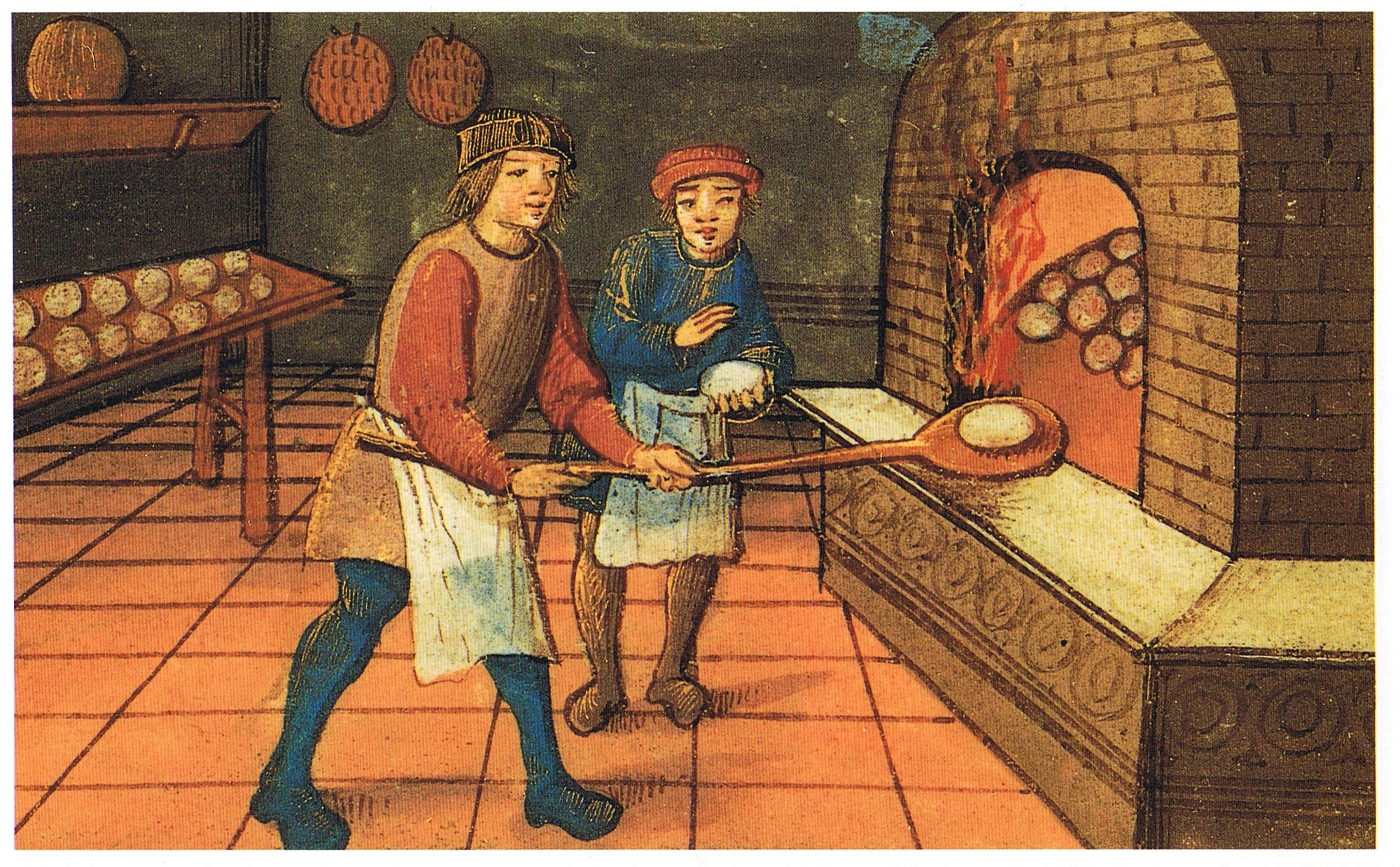
The illustration above shows a baker and his apprentice. For centuries, that is how people became experts: you did the simple work, badly at first, beside someone who knew better.
My younger brother graduated from college this year. He is finding that the bar for juniors has risen to new heights: employers expect more and more of them on day one. He is not alone. Among workers aged 22 to 25 in the most AI-exposed jobs, employment is now about 19% below where it would otherwise be, mostly because fewer of them are being hired.
If AI can do the junior work, where will the next generation of experts practice?
Two answers on the same day
On 22 September 2026, two very different institutions offered an answer. Andreessen Horowitz announced the Horowitz Andreessen Academy (HAA), a full-time program in San Francisco for about 50 students, mostly just out of high school, built around Courses, Co-ops and Pursuits (HAA, 2026a, 2026b; Torenberg, 2026). Its launch memo opens: “The internet made it possible to know anything. AI makes it possible to do anything.” Its posting for a founding Dean of Education says students will build high agency, AI-native building, people skills and ambition “not through traditional lectures, tests, grades, or homework - but through allowing students to create their own challenges and projects” (Andreessen Horowitz, 2026).
- About 50 students, from September 2027
- Courses, Co-ops and Pursuits
- Built for high agency and AI-native building
- Learning through projects, not grades
- 238 pages, a year-long process
- 18 faculty, 6,000+ stakeholders
- AI, government relations, public trust
- Asks what is “indispensably human” in learning
On the same day, Cornell, founded in 1865, published a 238-page report on the future of the American university. What struck me is that it does not treat AI mainly as a cheating problem. AI, it warns, can create “the appearance of learning without the intellectual formation that makes learning meaningful and durable” (Cornell, 2026, p. 11).
AI is very good at transmission. It can explain, summarize and increasingly produce competent work. Cornell’s answer is not to ban it, but to become “far more intentional about what remains indispensably human in the learning process” (p. 12), with more hands-on work in which students demonstrate, build, argue and solve problems. The catch is a paradox: using AI well takes judgment, yet leaning on AI too early lets students skip the experiences that build it.
So the question is not whether students should be allowed to use AI. The question is when.
The old apprenticeship bargain
When I started as an analyst at CPPIB, I was not particularly efficient. I wrote first drafts, built spreadsheets, reviewed documents and sat quietly in meetings. A senior associate could have done most of it faster, but I was coached to get better, and I am grateful for it.
That was the deal. Employing a junior produced two kinds of value:
The first term paid for the second. Along the way, juniors learned what a good memo looks like, when a number doesn’t look right and what a client is actually worried about. That is how professional judgment gets built. It matters that the Stanford researchers found the steepest declines in jobs built on codified knowledge, while experienced workers in jobs built on tacit knowledge, learned through practice and mentorship, have done fine (Stanford Digital Economy Lab, 2026).
AI changes the first term. Try for yourself by changing what % of routine work a junior does that AI can do and see how the apprenticeship economics change.
At the far end of the slider, the equation becomes:
“Hire this person because they do useful work while learning” is easy to defend. “Hire this person so that someone skilled exists in five years” is a much harder sell.
Two ladders
From here, the junior ladder can go two ways. In the first, senior staff use AI to do the junior work:
Universities should take this seriously, because they have always relied on employers to finish professional education. A university teaches accounting; a firm teaches you to be an accountant. If fewer employers need novices, who pays for that second stage of learning?
In the second, AI makes juniors more capable. A novice programmer can attempt what once took years of experience, and a junior analyst can test hypotheses much faster. That is the part of the HAA experiment I find most interesting:
For my brother’s generation, is it going to be a race to the bottom or a race to the top? How about in 10 years time, do the models of professional service firms for where associates become partners still exist, when the junior to partner pipeline dries up?
I have seen the second ladder up close. At Eskwelabs, a company I co-founded, our Education Innovation Fellowship began as a conventional internship: one manager worked closely with five to seven interns every six months. Good apprenticeship needed supervision, and supervision needed someone’s time.
My cofounder, who has run the company since 2024, has since scaled it to roughly 300 interns per cycle, partly by introducing AI managers that provide much of the day-to-day structure, guidance and feedback. It is one organization’s experience, not proof that the model generalizes, but it changed how I think about the economics of apprenticeship.
{{ ratioText }}
In the AI-supported model, the expert spends less time correcting routine work and more time asking the questions that build judgment. Why did you choose this approach? What evidence would change your mind? What did you miss? Would you put this in front of a client? These are exactly the situations Cornell says build judgment (Cornell, 2026, p. 41).
When should AI be in the room?
This makes when a teaching decision, not a technology policy. First decide what capability the student should build. Then decide whether AI should be absent, a coach or a colleague.
The teacher becomes less a source of information and more the designer of the sequence of experiences through which judgment develops. Try it on one of your own assignments.
An apprentice also learns what the master pays attention to, what counts as good work and how to act when there is no obvious right answer. Apprenticeship has always passed on values as well as skills. AI can pass on the information without the standards.
What a university could become
I don’t think universities should copy HAA. Its money, network and students are hard to replicate. But parts of it can be unbundled and scaled. Tap each card to see a university-sized version:
The point is not to replace professors with AI. It is to use AI to make the time between high-value human moments cheaper, so people can spend more of theirs on judgment, standards and feedback. Taken further, a degree could be organized around growing autonomy rather than courses and exams:
This isn’t a vocational model. Historians, scientists, artists and engineers all develop the same way: harder and harder practice, exposure to standards, and feedback from people who know more.
Making apprenticeship scalable
For a century, universities got very good at scaling the transmission of knowledge. One professor could teach hundreds of students. Apprenticeship stayed expensive, because expert attention did not scale.
AI may change that. If it does, its most important use in education may not be a better chatbot for every student. It may be making apprenticeship itself scalable, so that something that has looked like an elite experience becomes available to far more people.
The apprentice in the illustration learned beside the baker, loaf after loaf. My brother’s generation still needs somewhere to learn beside people who know better. Building that, at scale, may be the most useful thing a university can do with AI.